Related project requirement
Need specifications or pricing for DWC Pipe?
Share the quantity, drawing or specification and delivery location for a project-specific review.
Railway signalling cables connect equipment across stations, yards, level crossings and the open line. Damage can interrupt vital circuits, delay train operations and create extensive fault-finding work. Cable protection therefore begins with an engineered route and continues through excavation, duct selection, entry detailing, identification and ongoing control of work near the cable.
No single pipe or cover makes a cable route safe. The correct solution depends on soil and rock conditions, crossings, theft or digging risk, drainage, cable type and the approved railway standard. DWC-HDPE pipes, GI pipes, RCC ducts and cable troughs each serve different situations within that larger design.
Start with the cable route
A good route minimises unnecessary crossings, avoids predictable interference and remains accessible for authorised maintenance. It must coordinate with track, civil, electrical and telecom assets. Route plans, cable markers and records are part of protection because they reduce the chance of later work striking an unidentified cable.
Buried cable protection
Indian Railways guidance describes buried installation and the use of approved ducts or pipes to protect signalling cable in defined conditions. The required depth, trench construction and protection vary by location. Rocky ground, road or track crossings, station areas and theft-prone locations can require additional measures shown in the applicable drawings.
DWC-HDPE pipe
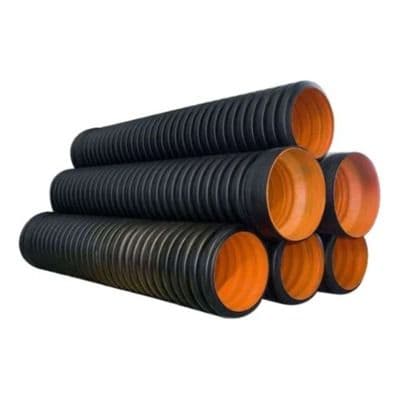
Double-wall corrugated HDPE pipe combines a corrugated outer wall with a smoother internal path. In cable applications, the outer profile contributes stiffness while the inner surface supports cable pulling. Selection should consider approved diameter, ring stiffness or load requirement, jointing, bend control, drainage and the length of cable pull.
View the Principal Vinimay DWC pipe catalog entry for railway project enquiries. The final size and class must follow the approved cable plan and specification.
GI pipe
Galvanised iron pipe may be specified where a rigid metallic sleeve or local mechanical protection is needed. Typical project decisions include diameter, wall requirement, finish, end treatment, joints, support and bonding. Sharp edges and poorly finished entries can damage a cable during pulling, so the complete installation detail matters.
Cable troughs and ducts
Trough systems provide a defined cable path and can support inspection or future access where the design permits. Covers, supports, drainage, continuity and transitions into pipes or equipment enclosures need to be resolved. An open or water-retaining trough can create new risks rather than solve them.
Protection at equipment entries
Many cable problems occur at transitions: where a buried duct rises into an apparatus case, where a pipe ends, or where a route turns sharply. The detail should control bend radius, abrasion, water entry, sealing and mechanical strain. Entries should also preserve the enclosure protection required by its specification.
Cable protection and earthing are related—but different
A protective pipe or trough guards the cable physically. Earthing and bonding manage electrical safety and specified surge or fault paths. Metallic protection, enclosures and equipment may require designed bonding, but the method cannot be inferred simply from the presence of metal. Follow the approved signalling, electrical and earthing drawings.
Practical inspection checklist
- Confirm the installed route, depth and protection against the approved drawing before backfilling.
- Inspect ducts and pipe interiors for obstruction, damage and sharp edges before pulling cable.
- Check joints, covers, supports, drainage and transition details.
- Respect the specified pulling tension and bend radius for the cable.
- Identify and record the route, crossings, joints and entries accurately.
- Verify required bonding, earthing and separation from other services.
Specify a system, not just a pipe
A useful procurement package identifies the pipe or trough, fittings, joints, end treatment, covers, supports and test requirements. Installation drawings should show where each protection method begins and ends. This avoids gaps between products that are individually suitable but poorly integrated.
Frequently asked questions
Why is DWC pipe used for railway signalling cables?
DWC-HDPE pipe can provide a defined protective duct with a corrugated outer wall and smoother inner path. Its use, size and performance class must follow the approved railway cable design.
When is GI pipe used for railway cable protection?
GI pipe may be specified as a rigid sleeve or local mechanical protection at crossings, entries or exposed sections. The exact application depends on the project drawing.
Is burying a signalling cable enough protection?
Not necessarily. Route conditions can require ducts, pipes, slabs, troughs, markers or other approved measures in addition to the specified burial arrangement.
Related railway guides
From research to procurement
Discuss your DWC Pipe requirement
Send the applicable drawing or specification, quantity, project location and expected schedule. Our team will review the manufacturing and supply scope.
References and further reading
- Indian Railways Signal Engineering Manual — Chapter 15: Cables — Indian Railways
- Outdoor Signalling — Installation, Testing and Maintenance of Equipment — Indian Railways
This educational material is a general overview. Project specifications, approved drawings and the latest applicable railway standards govern actual procurement, installation and maintenance.