Related project requirement
Need specifications or pricing for Sliding Boom Barrier?
Share the quantity, drawing or specification and delivery location for a project-specific review.
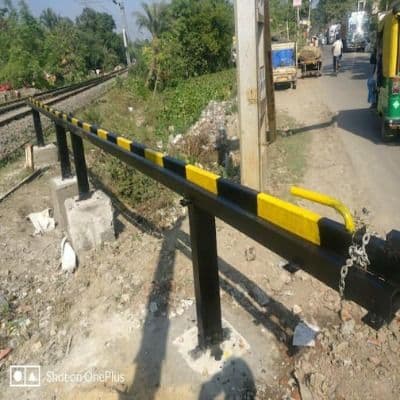
An emergency sliding boom supports the approved road-closure procedure at a railway level crossing when the normal lifting barrier cannot be closed. Its usefulness depends on correct positioning, unobstructed movement and positive securing at the far side of the road.
This checklist is a project review aid. The latest approved layout, drawing, railway instructions and authorised trial procedure remain the controlling requirements.
Before civil and mechanical work
Confirm the approved road opening, operating side, parked position, clearances, support and locking-post locations, foundation details, underground services and supplied accessories. Reconcile site measurements with the issued drawing.
Foundations and alignment
Check that supports and the locking post are positioned and aligned without narrowing the required road opening. Foundations, embedded items and fasteners should match the approved arrangement and permit the boom to move without binding.
Movement and securing
Operate the boom through its complete travel and check guides, handles, stops, supports and the locking interface. The boom should reach the closed position and be positively secured using the specified approved method.
Visibility and condition
Inspect prescribed markings, reflective treatment, road visibility, sharp edges, corrosion protection, deformation and loose hardware. The parked boom should not create an unintended obstruction.
Trial, records and maintenance access
Carry out the authorised trial operation and record observations, corrections and acceptance. Retain the drawing revision, location, lock or key details where applicable, inspection result and planned maintenance access.
Project checklist
- Approved layout and verified site dimensions
- Foundations, supports and locking-post alignment
- Full unobstructed boom movement
- Positive securing and controlled lock interface
- Visibility, marking and finish
- Trial operation and as-installed records
Review the sliding boom barrier product page for the related Principal Vinimay catalogue item and enquiry path.
Continue with the emergency sliding boom guide for supporting context.
Use the approved project documents
This article explains terminology, interfaces and procurement questions. The latest approved railway rules, drawings, specifications and project instructions remain the controlling requirements for design, installation, testing and operation.
Frequently asked questions
What is the most important sliding-boom installation check?
Confirm that the boom moves across the approved road opening and can be positively secured in the closed position without obstruction or misalignment.
Should the locking post be positioned from site judgement alone?
No. Use the approved layout and verified site dimensions, with changes handled through the authorised design process.
What should be recorded at handover?
Record the location, drawing revision, supplied arrangement, trial and inspection results, corrections and required lock or maintenance information.
Related railway guides
From research to procurement
Discuss your Sliding Boom Barrier requirement
Send the applicable drawing or specification, quantity, project location and expected schedule. Our team will review the manufacturing and supply scope.
References and further reading
- Safety Precautions and Installation/Maintenance Guidelines for Level Crossing Gates — Indian Railways / CAMTECH
- Emergency Operations in Signal Interlocking Systems — Indian Railways / CAMTECH
- Indian Railways Signal Engineering Manual — Chapter 8: Drawings and Specifications — Indian Railways
This educational material is a general overview. Project specifications, approved drawings and the latest applicable railway standards govern actual procurement, installation and maintenance.