Related project requirement
Need specifications or pricing for Sliding Boom Barrier?
Share the quantity, drawing or specification and delivery location for a project-specific review.
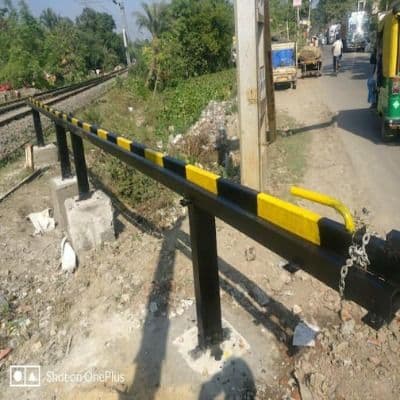
An emergency sliding boom is a manually positioned barrier used at a railway level crossing as part of the approved contingency arrangement. Indian Railways guidance describes its use when a lifting barrier cannot be closed because of failure or damage.
It is not a routine substitute chosen independently by a supplier. Its location, locking, road indication, dimensions and operating procedure must match the level-crossing design and the railway’s instructions.
Key points
- Supports closure of the road during a defined lifting-barrier failure
- Is installed as part of the approved level-crossing arrangement
- Requires a positive securing or locking method
- Must be visible, maintainable and compatible with the road width and site layout
Role in the level-crossing system
The sliding boom helps establish a physical road closure when the normal lifting barrier is unavailable. It works with authorised procedures, signals, road indications and staff actions; the fabricated boom alone cannot establish safe working.
Sliding action versus lifting action
A lifting barrier rotates vertically around a pivot. A sliding boom is moved across the road and secured at the opposite side. The different motion changes the foundation, clearances, support, locking-post position and maintenance needs.
Main hardware interfaces
A complete project arrangement can include the boom, guide or support structure, locking post, handle, stop arrangement, reflective treatment, lock interface, fasteners and foundations. The exact scope should be listed rather than inferred from a product name.
Information needed before fabrication
Confirm the clear road opening, side clearance, operating direction, parking position, locking arrangement, approved drawing, material, finish and civil interfaces. Site measurements should be reconciled with the issued drawing before manufacture.
Project checklist
- Approved layout and road opening
- Boom length and operating clearance
- Locking and securing arrangement
- Foundation and support interfaces
- Visibility and marking requirements
- Inspection, trial operation and records
Review the sliding boom barrier product page for the related Principal Vinimay product configuration and enquiry path.
For wider context, continue with the E-Type Locks product page.
Final selection rule
Use the latest approved project drawings, specifications and railway instructions as the controlling requirements. This article explains terminology and selection questions; it does not replace design approval, signalling principles or site-specific engineering.
Purpose of a railway sliding boom
A sliding boom is a horizontally moving barrier used within an approved railway level-crossing arrangement. It should be understood as one element of the complete gate layout rather than as a stand-alone safety system. The site plan, operating method, locking arrangement, road width, visibility and interfaces with other gate equipment determine the installed configuration.
- Confirm the clear opening and required closed position.
- Define the direction of travel and safe storage position.
- Coordinate the boom with road geometry, fencing, posts and operating space.
Sliding boom versus lifting barrier
A sliding boom translates horizontally, while a lifting barrier rotates vertically. This changes the required foundations, swept area, operating clearances, counterbalancing and locking details. One cannot be substituted for the other merely because both restrict road traffic. The approved level-crossing arrangement and operating instructions govern the choice.
- Check horizontal movement space for a sliding boom.
- Check overhead and rotational clearance for a lifting barrier.
- Confirm manual effort, locking, visibility markings and maintenance access for either design.
Installation and acceptance checks
Before acceptance, verify foundations and alignment, free movement, end positions, locking, fasteners, visibility treatment, clearances and trial operation. Record the inspection against the approved drawing and site plan. Any change to the gate arrangement should be reviewed through the authorised railway process.
Next step for a project enquiry
Use the sliding boom installation checklist to capture the controlling technical and commercial inputs.
View the sliding boom barrier product page for the relevant manufactured product and enquiry path.
Frequently asked questions
What is a sliding boom in railway level crossings?
It is a horizontally moving barrier used as part of an approved level-crossing gate arrangement to restrict road movement when required.
Is a sliding boom the same as a lifting barrier?
No. Their movement, foundations, clearances, operating arrangement and locking requirements differ.
What should be checked before installing a sliding boom?
Check the approved layout, opening width, foundations, alignment, movement space, locking, visibility, fasteners and trial operation.
Can a sliding boom be selected without a site plan?
It should not be. Road geometry and the approved level-crossing arrangement are essential selection inputs.
Related railway guides
From research to procurement
Discuss your Sliding Boom Barrier requirement
Send the applicable drawing or specification, quantity, project location and expected schedule. Our team will review the manufacturing and supply scope.
References and further reading
- Safety Precautions and Installation/Maintenance Guidelines for Level Crossing Gates — Indian Railways / CAMTECH
- Emergency Operations in Signal Interlocking Systems — Indian Railways / CAMTECH
- Indian Railways Signal Engineering Manual — Chapter 8: Drawings and Specifications — Indian Railways
This educational material is a general overview. Project specifications, approved drawings and the latest applicable railway standards govern actual procurement, installation and maintenance.