Related project requirement
Need specifications or pricing for Indoor Wiring Racks?
Share the quantity, drawing or specification and delivery location for a project-specific review.
CTR, CRR and relay rack are equipment-room terms used for different termination, relay-mounting or combined functions in railway signalling. Their exact expansion and supply scope must be confirmed from the approved rack drawing, equipment schedule and project terminology.
The equipment schedule, terminal schedule, room layout and rack general-arrangement drawing are the dependable sources for capacity, construction and interfaces.
Key points
- A termination rack is organised around cable and circuit interfaces
- A relay rack is organised around signalling relays and their wiring
- A composite rack can combine functions when the approved design permits
- Acronyms should always be tied to a drawing and revision
Cable termination function
A termination rack provides structured positions for field-cable and internal-wiring terminations. Terminal quantity, segregation, identification, cable support and test access shape the design.
Relay mounting function
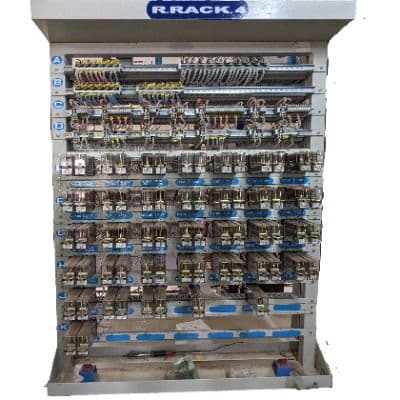
A relay rack provides repeatable mounting positions for specified relays, bases and associated wiring. Equipment depth, removal space, wire routing and labelling affect the physical arrangement.
Composite arrangements
A composite rack can place more than one function in a coordinated frame. This may save room, but density, access, heat, segregation and future additions must be assessed together.
Turning terminology into a manufacturable scope
Attach the current rack drawing, equipment list, terminal schedule and room interface. Define material, finish, anchoring, cable entry, accessories, spare positions and inspection documents.
Project checklist
- Rack function and approved acronym
- GA drawing and revision
- Equipment and terminal schedules
- Cable entry and wire-management layout
- Room footprint and maintenance clearances
- Material, finish and anchoring
Review the indoor wiring racks product page for the related Principal Vinimay product configuration and enquiry path.
For wider context, continue with the railway relay-rack selection guide.
Final selection rule
Use the latest approved project drawings, specifications and railway instructions as the controlling requirements. This article explains terminology and selection questions; it does not replace design approval, signalling principles or site-specific engineering.
Why CTR and CRR should not be expanded blindly
In railway signalling projects, CTR and CRR are commonly used rack labels, but their expansion and scope can depend on the organisation, project documents and room arrangement. CTR is often used for a cable termination rack, while CRR may be used for a cable termination-cum-relay rack or another project-defined combination. The approved rack drawing and equipment schedule are therefore more reliable than the acronym alone.
- Quote the rack designation exactly as shown on the approved drawing.
- Attach the equipment and termination schedule to the enquiry.
- Ask the designer to resolve ambiguous acronyms before manufacture.
Functional differences that affect rack construction
A termination-focused rack prioritises terminal capacity, cable entry, segregation and wire management. A relay or combined rack also has to accommodate equipment mounting, access, clearances and additional wiring paths. These differences affect frame dimensions, panel arrangement, ducts, terminal rails, cable supports, labels and inspection points.
- Count terminals and equipment positions from controlled schedules.
- Plan incoming and outgoing cable routes and bend space.
- Maintain the required segregation, access and identification.
A better way to specify a railway rack
Specify the rack by drawing and function, then list dimensions, material, finish, mounting plates and rails, terminals, wire ducts, cable-entry direction, segregation, earthing, labels, supplied hardware and documentation. Include room-layout and interface drawings where they influence the rack. This removes more uncertainty than adding extra acronyms to the item name.
Next step for a project enquiry
Read the railway signalling rack layout guide to capture the controlling technical and commercial inputs.
View indoor wiring racks for the relevant manufactured product and enquiry path.
Frequently asked questions
What is the full form of CTR in railway signalling?
CTR is often used for Cable Termination Rack, but the approved project drawing and terminology should be checked before relying on that expansion.
What is CRR in railway signalling?
CRR can refer to a combined cable-termination and relay-rack function in some project documents. Its exact scope must be confirmed from the drawing and equipment schedule.
Is a CTR the same as a relay rack?
Not necessarily. A termination rack and a relay or combined rack can differ significantly in equipment, layout and interfaces.
What information is needed to order a signalling rack?
Provide the controlled drawing, equipment and terminal schedules, dimensions, material, internal hardware, cable routing, segregation, earthing, labels and inspection requirements.
Related railway guides
From research to procurement
Discuss your Indoor Wiring Racks requirement
Send the applicable drawing or specification, quantity, project location and expected schedule. Our team will review the manufacturing and supply scope.
References and further reading
- Indian Railways Signal Engineering Manual — Chapter 8: Drawings and Specifications — Indian Railways
- Indian Railways Signal Engineering Manual — Chapter 7: Essentials of Signalling — Indian Railways
- Outdoor Signalling — Installation, Testing and Maintenance of Equipment — Indian Railways
This educational material is a general overview. Project specifications, approved drawings and the latest applicable railway standards govern actual procurement, installation and maintenance.