Related project requirement
Need specifications or pricing for Route Indicators Metallic/FRP?
Share the quantity, drawing or specification and delivery location for a project-specific review.
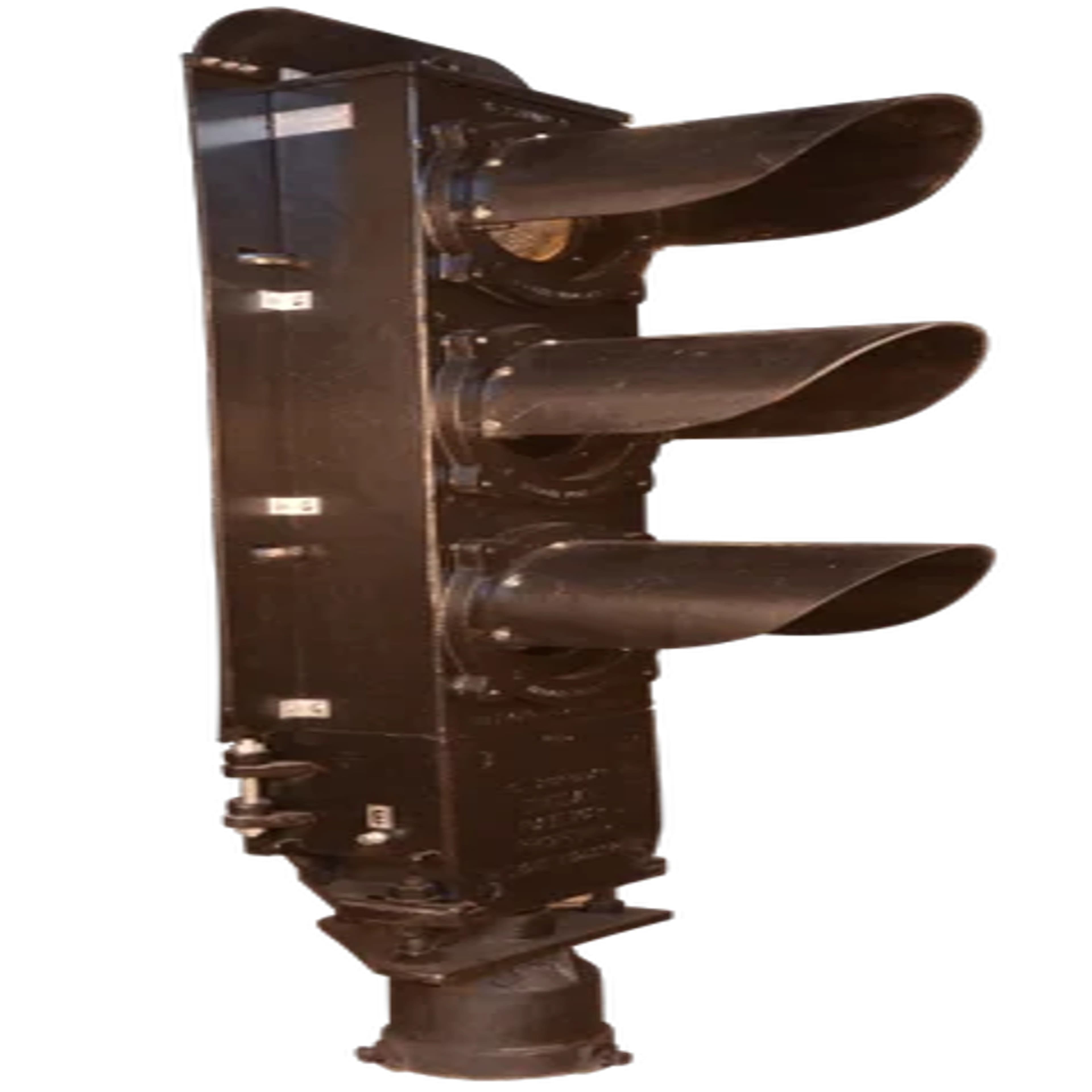
A junction-type route indicator gives directional information for a diverging route by illuminating an approved spatial pattern associated with the main signal. The position of the illuminated row or arm helps identify the route that has been set.
It supplements the associated signal aspect and is not independent authority to proceed. The signal plan, operating rules, sighting decision and interlocking design remain controlling requirements.
How the indication works
The display uses an approved arrangement of light units to show the direction of the selected divergence. The exact number, spacing, angle and position of the units must follow the applicable drawing and railway requirement.
Difference from stencil type
A stencil indicator presents an illuminated letter or number through a prepared display. A junction indicator primarily communicates direction through the spatial position of its lights.
Difference from multi-lamp type
A multi-lamp indicator uses a matrix or arranged lamps to form a character. A junction indicator uses the geometric arrangement itself as the route information, so the two should not be treated as interchangeable housings.
Sighting and mounting
The indicator has to be read with its associated signal from the required approach. Mounting height, offset, background, angular alignment, obstruction clearance and relationship to adjacent signals therefore need project-specific approval.
Information for an enquiry
State the approved type, every required directional display, associated signal, mounting arrangement, housing material, light-unit scope, electrical and proving interface, drawing revision and inspection requirements.
Project checklist
- Approved route and directional displays
- Associated signal and mounting position
- Light-unit arrangement and spacing
- Housing, hood and background interfaces
- Electrical supply and proving boundary
- Drawing, inspection and identification
Review the route indicators product page for the related Principal Vinimay catalogue item and enquiry path.
Continue with the railway route-indicator guide for supporting context.
Use the approved project documents
This article explains terminology, interfaces and procurement questions. The latest approved railway rules, drawings, specifications and project instructions remain the controlling requirements for design, installation, testing and operation.
What a junction type route indicator communicates
A junction type route indicator supplements the associated signal by presenting an approved directional display for a diverging route. It is intended to convey route information, not to replace the movement authority given by the signal aspect. Reading the route indicator and signal as unrelated devices can therefore lead to an incorrect explanation of their function.
- The signal aspect and route indication form part of one operating display.
- The illuminated direction must correspond to the proved and authorised route.
- The exact pattern and application follow approved railway instructions.
Sighting, mounting and electrical interfaces
The indicator must be visible and unambiguous from the required approach while remaining compatible with the signal structure and available clearances. Procurement should identify orientation, mounting points, housing, light-source arrangement, electrical ratings, proving requirements and access for maintenance. Electrified territory may introduce additional clearance considerations that the approved design must address.
- Record the required viewing point and display orientation.
- Confirm structural mounting and cable-entry interfaces.
- Define inspection of the complete displayed pattern, not only individual lamps.
Questions to resolve before manufacture
Before manufacture, freeze the route display, drawing revision, housing construction, finish, mounting, wiring, labels, supplied hardware and acceptance tests. Any uncertainty about the operational display should be resolved by the authorised signalling designer rather than interpreted by the fabricator.
Next step for a project enquiry
Compare stencil and junction route indicators to capture the controlling technical and commercial inputs.
View railway route indicator products for the relevant manufactured product and enquiry path.
Frequently asked questions
What is a junction type route indicator?
It is a directional display used with a railway signal to indicate the selected diverging route in an approved signalling arrangement.
Does a route indicator give movement authority?
The movement authority is conveyed by the associated signal aspect; the route indicator supplements it with route information.
What affects route indicator sighting?
Approach geometry, viewing distance, alignment, background, signal position, display brightness and applicable clearances all matter.
What should a purchase specification define?
It should define the approved display, drawing, housing, mounting, electrical interface, proving, cable entry, inspection and documents.
Related railway guides
From research to procurement
Discuss your Route Indicators Metallic/FRP requirement
Send the applicable drawing or specification, quantity, project location and expected schedule. Our team will review the manufacturing and supply scope.
References and further reading
- Chapter III — Signals — South Western Railway
- Indian Railways General Information — Signals and Route Indicators — South East Central Railway
- Selection Circuits and Control Tables — Route Indicators — IRISET / Indian Railways
- Indian Railways Signal Engineering Manual — Essentials of Signalling — Ministry of Railways, Government of India
This educational material is a general overview. Project specifications, approved drawings and the latest applicable railway standards govern actual procurement, installation and maintenance.