Related project requirement
Need specifications or pricing for Signal Unit Complete?
Share the quantity, drawing or specification and delivery location for a project-specific review.
A railway signalling system controls and protects train movements by combining operating rules, approved signalling principles, field equipment, control logic, detection and human procedures. The visible signal is only one part of that arrangement.
Understanding the system boundary helps buyers avoid treating individual hardware as standalone equipment. Each item must match the approved design and its electrical, mechanical and operational interfaces.
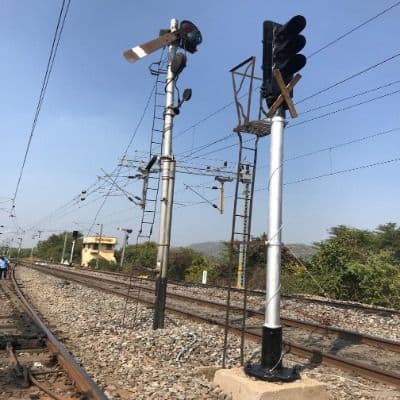
Signals and route information
Stop signals display the approved aspects, while route indicators can provide supplementary route information. Sighting, aspect sequence, location and association with the controlled route are design inputs rather than catalogue choices.
Train detection
Track circuits and axle-counter arrangements provide information about track occupancy according to the approved system design. Trackside junction boxes, cables and terminations form physical interfaces within that detection arrangement.
Points and interlocking
Point operation and detection establish the position of movable track components. Interlocking logic checks the required conditions before a route and its associated signal can be cleared.
Control and equipment rooms
Panels, electronic interfaces, relays, racks, terminals, power supplies and data equipment are organised in equipment rooms. Controlled diagrams connect the logical design to the physical wiring and rack arrangement.
Installation and assurance
Drawings, specifications, factory inspection, site installation, testing and approved commissioning evidence establish that the supplied equipment matches the design. Alterations must follow the authorised change process.
Project checklist
- Operating and signalling requirements
- Approved signalling plan and control tables
- Detection and point interfaces
- Signal, cable and power interfaces
- Equipment-room drawings and schedules
- Testing, records and commissioning authority
Review the complete railway signal unit for the relevant Principal Vinimay product and enquiry path.
Continue with the railway signal aspects guide for related technical or procurement context.
Use current approved documents
This article is an educational and procurement-planning guide. The latest approved railway rules, drawings, specifications, quality plans and project instructions remain the controlling requirements for design, supply, installation, testing, commissioning and operation.
Frequently asked questions
Is a railway signal the same as a signalling system?
No. The signal is a field component within a wider system that also includes detection, interlocking, points, control, power, cables and operating procedures.
What controls the hardware configuration?
The approved signalling design, drawings, specifications, interfaces and project requirements control the configuration.
Why are testing records important?
They provide evidence that equipment and interfaces were checked against the approved design before authorised use.
Related railway guides
From research to procurement
Discuss your Signal Unit Complete requirement
Send the applicable drawing or specification, quantity, project location and expected schedule. Our team will review the manufacturing and supply scope.
References and further reading
- Indian Railway Signal Engineering Manual — Chapter 7: Essentials of Signalling — Ministry of Railways, Government of India
- Indian Railways Signal Engineering Manual, Part I — Ministry of Railways, Government of India
- IRISET Signal Notes — Indian Railways Institute of Signal Engineering and Telecommunications
- Outdoor Signalling — Installation, Testing and Maintenance of Equipment — Ministry of Railways, Government of India
This educational material is a general overview. Project specifications, approved drawings and the latest applicable railway standards govern actual procurement, installation and maintenance.