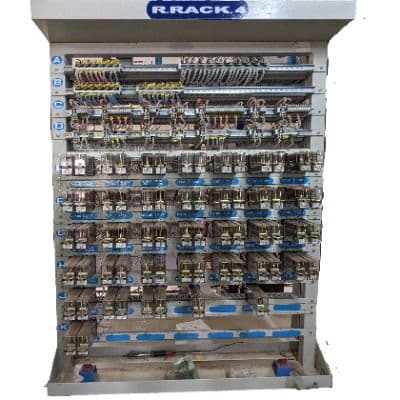
Related project requirement
Need specifications or pricing for Indoor Wiring Racks?
Share the quantity, drawing or specification and delivery location for a project-specific review.
Dimensional inspection confirms whether fabricated equipment matches the controlled drawing and will interface with its site, internal equipment and adjoining parts. Checking only overall height and width can miss the dimensions that matter most during installation.
An effective inspection plan identifies critical features, specified tolerances, measurement methods and hold points before fabrication is complete. Results should be recorded against the exact drawing revision used.
Establish the inspection baseline
Confirm drawing number, revision, approved deviations and applicable specification. Mark superseded documents clearly so measurements are not taken against the wrong issue.
Identify critical interfaces
Prioritise base and fixing holes, equipment mounting points, cable entries, door clearances, mating parts and any dimension that coordinates with civil or electrical work.
Choose suitable measurement methods
Match tools and technique to the required tolerance and geometry. Record equipment identification or calibration status where the quality plan requires it.
Inspect progressively
Early checks can catch base, frame and hole-pattern errors before coating or assembly makes correction difficult. Define hold or witness points in the approved inspection plan.
Record results and nonconformities
A report should identify the item, drawing, characteristic, requirement, measured result, status and inspector. Deviations require authorised disposition rather than silent adjustment of records.
Project checklist
- Drawing number and revision
- Approved tolerances
- Critical interface dimensions
- Suitable measuring equipment
- Progressive inspection stages
- Results and deviation disposition
Review the indoor wiring racks product page for the relevant Principal Vinimay product and enquiry path.
Continue with the signalling rack-layout guide for related technical or procurement context.
Use the approved project documents
This guide is a planning and procurement aid. The latest approved railway rules, drawings, specifications, quality plans and project instructions remain the controlling requirements for design, manufacture, installation, testing and acceptance.
Frequently asked questions
Which dimensions should be checked first?
Prioritise dimensions that control fixing, mounting, cable entry, access and interfaces with other equipment or site work.
Why inspect before coating?
Some frame, hole and interface errors are easier to verify and correct before finishing and final assembly.
What should a dimensional report contain?
Identify the item and drawing revision, required characteristic and tolerance, measured result, status, date and responsible inspector.
Related railway guides
From research to procurement
Discuss your Indoor Wiring Racks requirement
Send the applicable drawing or specification, quantity, project location and expected schedule. Our team will review the manufacturing and supply scope.
References and further reading
- Signal Engineering Manual, Volume I — Indian Railways
- Handbook on Indian Railway Standard Drawings and Specifications for Signalling — Indian Railways / CAMTECH
- Guidelines for Fabrication of Steel Girder Bridges, BS-130 — Indian Railways
This educational material is a general overview. Project specifications, approved drawings and the latest applicable railway standards govern actual procurement, installation and maintenance.