Related project requirement
Need specifications or pricing for TLJB Junction Box?
Share the quantity, drawing or specification and delivery location for a project-specific review.
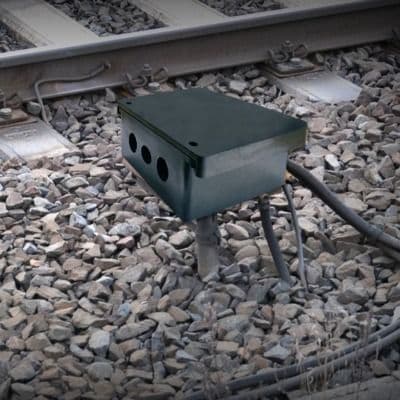
TLJB means track lead junction box. It is a specific trackside cable-interface item used in defined signalling or train-detection arrangements. A general junction box also joins or terminates conductors, while an apparatus case is normally a larger enclosure that can house multiple items of signalling equipment and extensive wiring.
The three names describe different functions, not simply three sizes of the same box. The controlling plan, cable schedule, equipment manual and approved drawing should identify which item belongs at each location.
Key points
- Use TLJB only when the approved design calls for the defined track-lead interface.
- Treat “junction box” as incomplete procurement language until terminals, entries and drawing are stated.
- Use an apparatus case where the design needs a larger protected equipment and termination location.
- Never substitute one enclosure type using dimensions alone.
What a TLJB does
A TLJB creates an accessible transition between the trackside lead and the onward cable arrangement defined for the system. The equipment manual may prescribe separate cable entries, terminals, links, inner protection or mounting. Those details are system-specific; TLJB should not be expanded into a generic label for every small trackside box.
Where a general junction box fits
A junction box provides a local termination or interconnection point. Its suitability depends on conductor count, terminal type, cable diameter, sealing, material, mounting and environmental exposure. A request for “one railway junction box” is therefore not enough to manufacture or compare a compliant product.
Why an apparatus case is different
An apparatus case or location box normally offers substantially more usable space for terminals and signalling equipment. Internal shelves, equipment mounting, doors, locks, earthing provisions and multiple cable entries can all form part of the approved arrangement.
How to choose correctly
Start with the approved track-circuit or signalling plan. Trace each cable, identify the equipment at the location, and check the referenced drawing. Confirm the latest revision before converting the design into a bill of materials or purchase order.
Project checklist
- Exact item name and function
- Applicable drawing number and revision
- Cable types and entry sizes
- Terminal, link and internal mounting details
- Housing material, mounting and locking
- Inspection and documentation requirements
Review the TLJB Junction Box product page for the related Principal Vinimay product configuration and enquiry path.
For wider context, continue with the apparatus case guide.
Final selection rule
Use the latest approved project drawings, specifications and railway instructions as the controlling requirements. This article explains terminology and selection questions; it does not replace design approval, signalling principles or site-specific engineering.
TLJB full form and practical role
TLJB commonly means Track Lead Junction Box in railway signalling. It is used at a defined field interface where track-side leads or cables need an enclosed, identifiable and maintainable termination point. The letters describe the intended interface; they do not by themselves define the enclosure material, terminal quantity, cable entries or mounting arrangement. Those details must come from the approved drawing and project specification.
- Confirm the exact drawing and revision before using the term TLJB in an enquiry.
- State the number and size of incoming and outgoing cables.
- Define terminal quantity, identification, mounting and earthing requirements.
TLJB, general junction box and apparatus case compared
A TLJB is normally associated with a specific track-lead interface. A general junction box can be used for a wider range of cable transitions and should therefore be described by function rather than name alone. An apparatus case or location box is usually a larger enclosure capable of housing terminations and additional signalling equipment. Selecting among them depends on the installed equipment, available space, cable route, access and the controlling design documents.
- Use a TLJB where the approved design calls for a compact track-lead termination interface.
- Use a junction box only after its cable and termination function is clearly defined.
- Use an apparatus case where the location needs more internal space, equipment or maintainable wiring.
What a purchase enquiry should contain
A useful enquiry identifies the item by drawing rather than acronym alone. Include quantity, enclosure material and finish, dimensions, terminal arrangement, cable-entry details, mounting, locking, labels, supplied hardware, inspection requirements and documentation. If any detail is unknown, mark it for confirmation instead of allowing the supplier to infer a safety-critical interface.
Next step for a project enquiry
Use the printable railway signalling RFQ checklist to capture the controlling technical and commercial inputs.
Review the TLJB Junction Box product page for the relevant manufactured product and enquiry path.
Frequently asked questions
What is the full form of TLJB in railway signalling?
TLJB commonly stands for Track Lead Junction Box. The approved project drawing should still be checked because construction and interfaces can vary.
Is a TLJB the same as an apparatus case?
No. A TLJB is generally a compact termination interface associated with track leads, while an apparatus case is usually a larger enclosure that may contain terminations and other signalling equipment.
What should be specified when ordering a TLJB?
Specify the controlling drawing, quantity, material, dimensions, terminals, cable entries, mounting, locks, labels, accessories, tests and required documents.
Can TLJB dimensions be selected from the acronym alone?
No. Dimensions and construction must follow the approved drawing and project requirements.
Related railway guides
From research to procurement
Discuss your TLJB Junction Box requirement
Send the applicable drawing or specification, quantity, project location and expected schedule. Our team will review the manufacturing and supply scope.
References and further reading
- FAdC R2 Technical Manual — Track Lead Junction Box — East Central Railway / Frauscher Sensor Technology
- Indian Railways Signal Engineering Manual — Chapter 8: Drawings and Specifications — Indian Railways
- Outdoor Signalling — Installation, Testing and Maintenance of Equipment — Indian Railways
This educational material is a general overview. Project specifications, approved drawings and the latest applicable railway standards govern actual procurement, installation and maintenance.